Skip to Content

The Hardest Part of This Question Isn't the Maths.

And the Minister's point is NOT about getting the final answer.
March 4, 2026 by
The Hardest Part of This Question Isn't the Maths.
Moses Wong
| No comments yet


In my previous post, I wrote about what the public reaction to this question revealed about how we learn and teach Maths. The Minister was making a point about how PSLE Mathematics questions have evolved, and what that evolution demands from students.

Modern PSLE maths questions increasingly come with scaffolding: the problem is broken into smaller parts, each one guiding the student toward the next. On the surface, this looks like the exam is being made easier. It isn't. The scaffolding changes what is being tested.

Instead of testing whether a student can compute a final answer, scaffolded questions test whether a student can follow a logical sequence, and understand why each step comes before the next.

This post is just the solution - but I want to walk through the thinking, not just the working. Because the working alone doesn't tell you why the sequence matters.


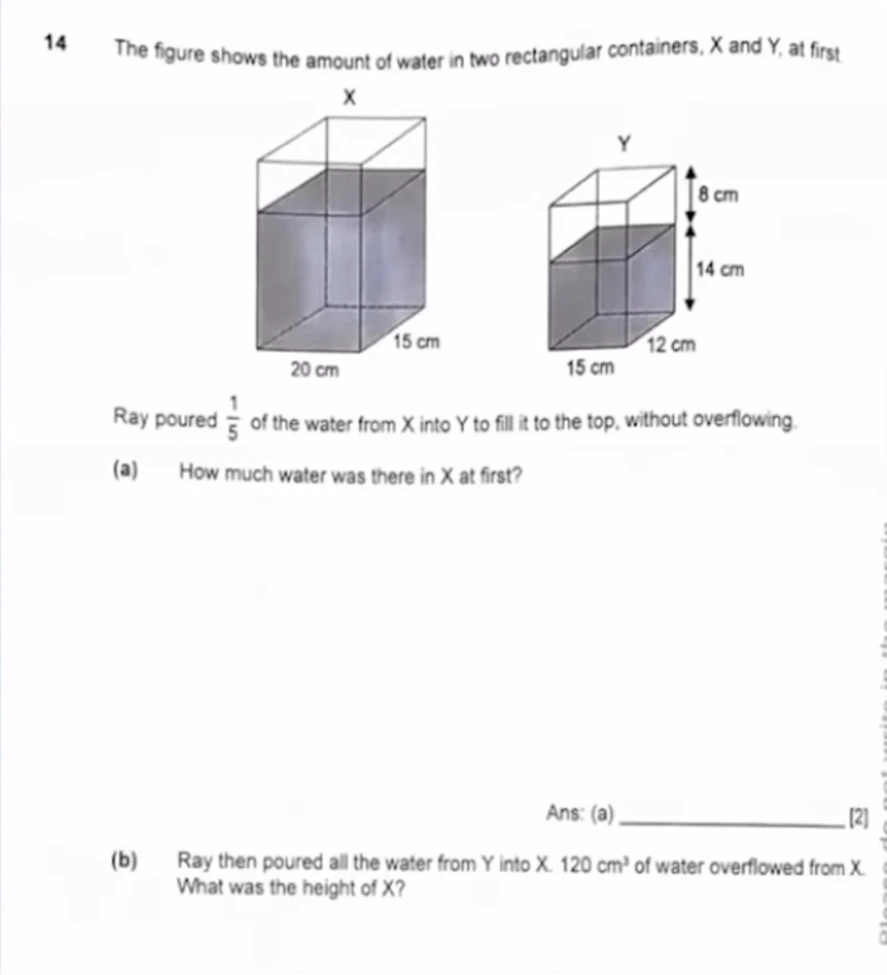
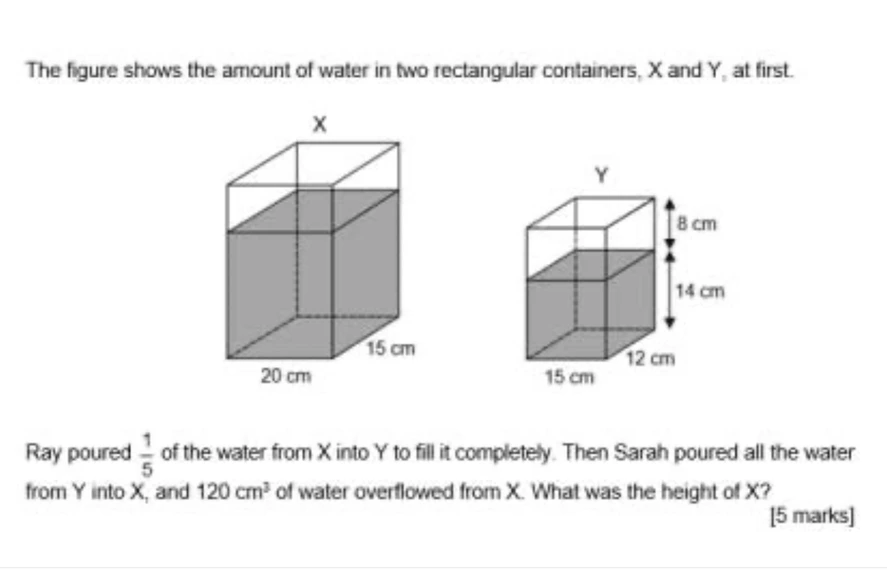
Here are the 2 versions of the questions.

What the Scaffolding is Actually Doing

The question gives you a lot of information. Two tanks. Multiple measurements. A fraction. An overflow figure. Most people read all of that and immediately reach for the numbers they recognise - and that is exactly where things go wrong.

In the first version, what's the question asking for? The height of Tank X.

Everything else are information that you need to build the path. But if you don't know what you are ultimately trying to find, you won't know what each piece of information is for.

But in the second version, you are given a smaller problem to solve first before finding the height of Tank X.

This is deliberate. The question is teaching students how a plan is built, by decomposing a complex problem into a chain of dependent steps. Each sub-question is one link in that chain. Remove any link, and the chain breaks.

But here is what scaffolding cannot do: it cannot tell you why the steps are in that order. It gives you the what. The student still needs to supply the why,  and that understanding is what separates a student who can follow the scaffolding from one who can construct a plan independently on a different question.


Scaffolding guides the plan. 
It doesn't replace the understanding of why the plan works.


Once you see that, the sequence becomes clear. 
- You cannot find X's height without X's capacity.
- You cannot find X's capacity without knowing how much water moved between the tanks. 
- You cannot know how much water moved without understanding what happened in Tank Y. 
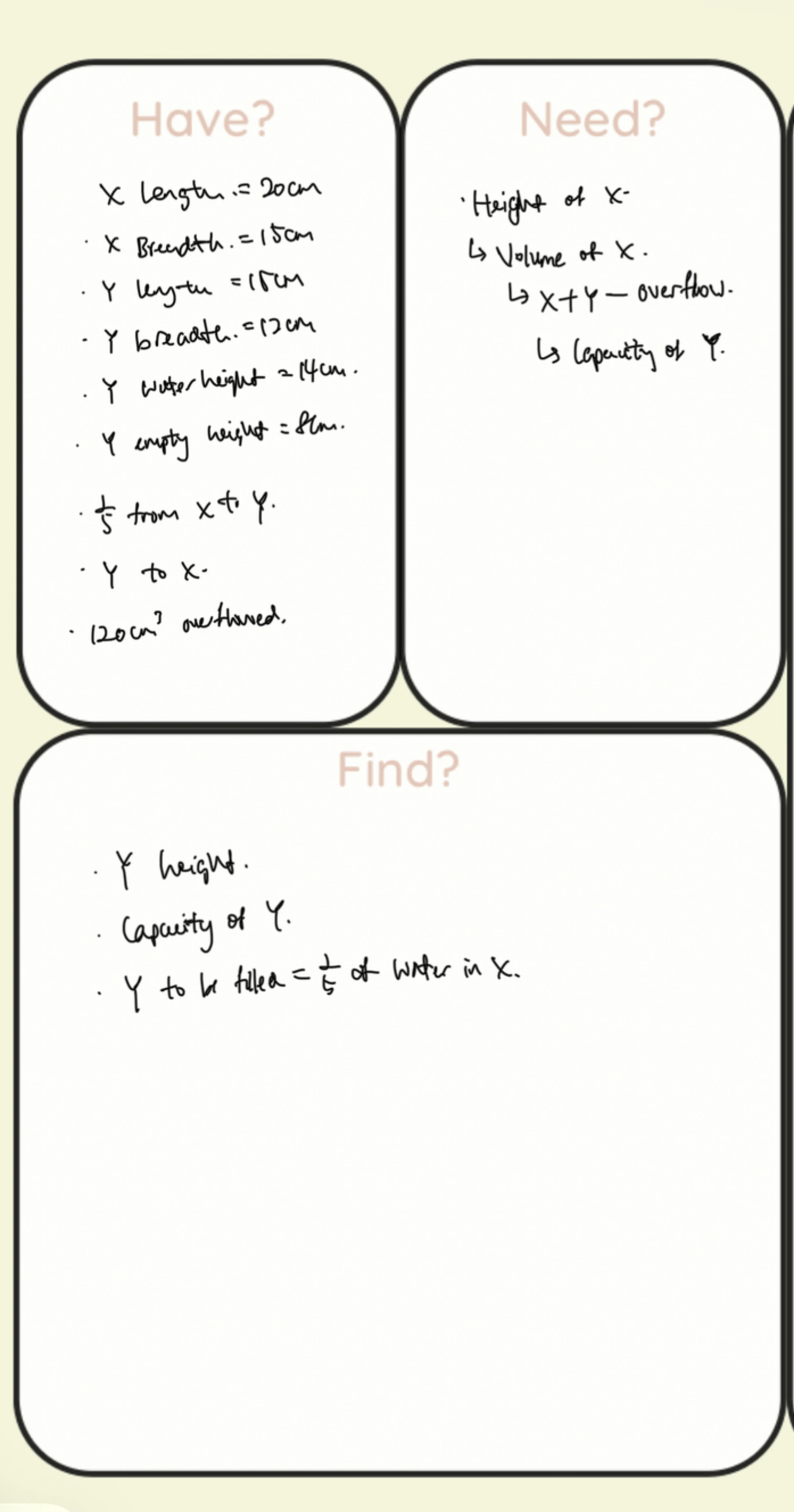
This is what the Have / Need / Find step in the MasterPlan does. It forces you to map the terrain before you start moving. By the time you pick up your pencil to calculate, the path is already decided.

Framing in the Masterplan


The Plan: Sequence Over Calculation

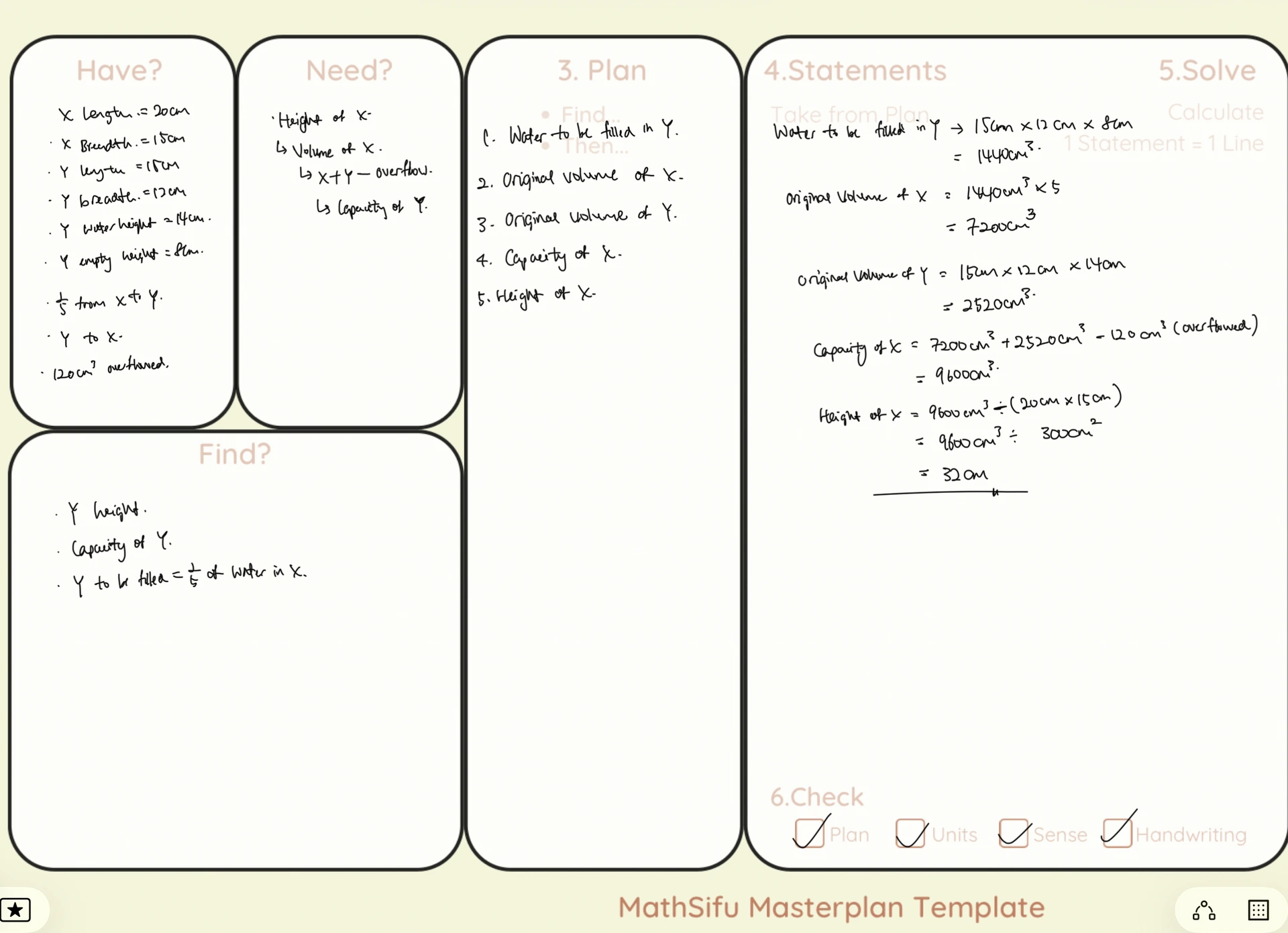
Once the framing is clear, the plan writes itself. There are 5 things to find, in this order.


1.  Water needed to fill Tank Y:  this tells us how much water moved from X

2.  Original volume of water in Tank X : before any transfer happened (This is Part A)

3.  Original volume of water in Tank Y  :  before any transfer happened
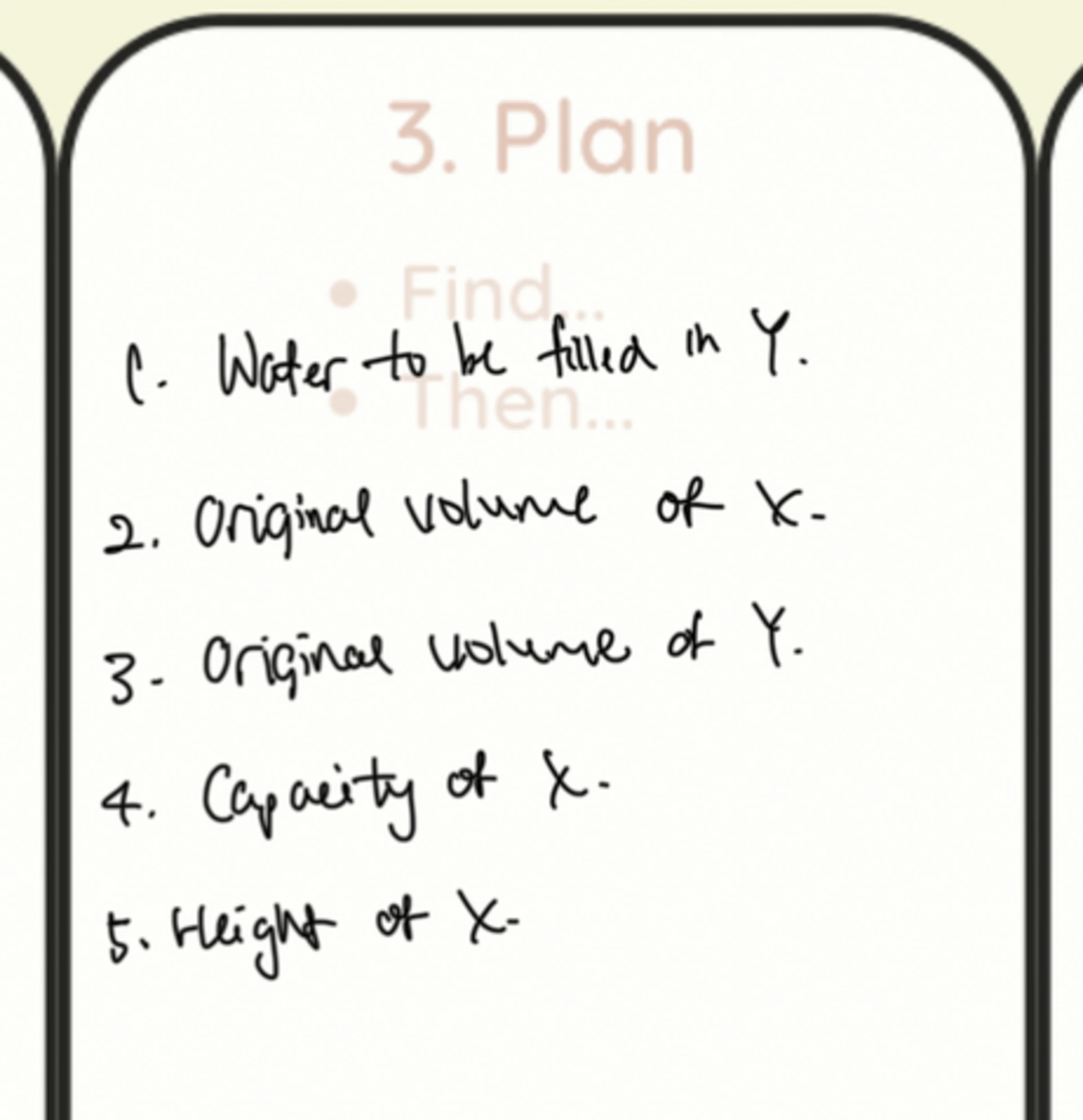
4.  Capacity of Tank X : using original volumes minus overflow

5.  Height of Tank X :  the answer (This is Part B)


This is exactly the sequence the question's scaffolding leads you through. But a student who understands the why, not just the what, can derive this plan themselves, with or without the sub-questions guiding them.

That is the deeper skill the Minister was pointing to. Scaffolding is a training wheel. The goal is for students to eventually ride without it.


The Full Working

Here is the full solution using the MathSifu Masterplan Framework. Each statement in the Statement and Solve section maps directly to one line in the Plan section. 

One Statement-> One Line.

What This Means for How We Prepare Students

As scaffolding and distributed weightage in marks is now a feature of PSLE maths, preparation needs to shift accordingly. Drilling calculation speed matters less. Developing the habit of reading a problem for its structure, before touching a single number, matters more.

A student who has been trained to ask "what do I need to find, and what do I need to find first?" will use the scaffolding well. They will see each sub-question as a confirmation of a path they have already begun to trace.

A student who has only been trained to recognise problem types and apply templates will struggle when the scaffolding runs out, or when a question's structure is slightly different from what they have seen before.

The question the Minister shared isn't hard because the maths is hard. It's hard because it requires a student to understand a sequence, and understand why that sequence is the only one that works.

That is a thinking skill. It is teachable. And it is exactly what structured problem-solving frameworks are designed to build.


The answer to this question is (a) 7200cm^3 (b)32cm. The Minister's point was never about whether adults could get there.


It was about whether we are building students who can think their way through a sequence, not just follow one.

Read the companion post -> “Give Back to Teacher Liao” -  This Worries Me  

→ Explore the MathSifu Playbook: mathsifu.com/masterplan



The Hardest Part of This Question Isn't the Maths.
Moses Wong March 4, 2026
Share this post
Archive
Sign in to leave a comment