
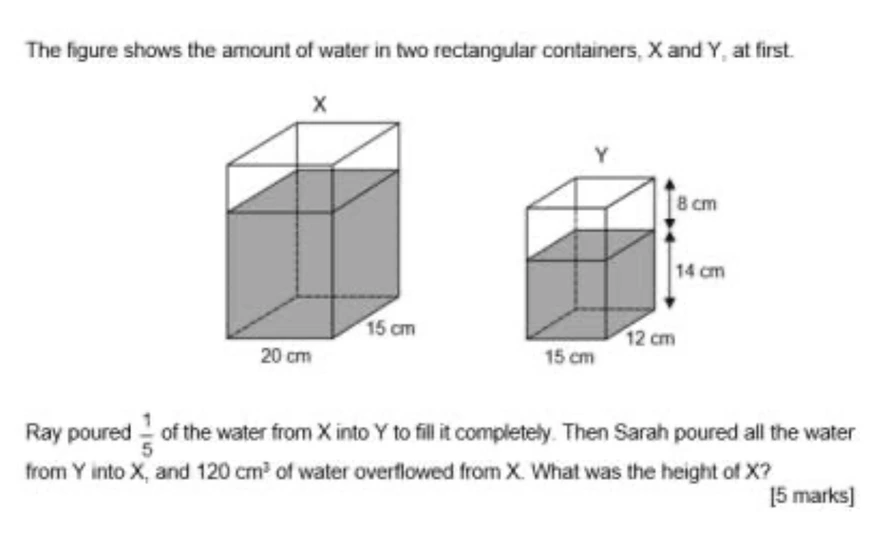
Recently, Minister of Education Desmond Lee shared a PSLE Mathematics question during a session in Parliament. The question made its rounds quickly - shared across Facebook groups, Whatsapp chats, and comments section, with parents and adults trying their hand at it.
Within hours, one comment type dominated every thread.
"Give back to teacher liao."
People laughed. Others liked the comment. And we moved on.
I didn't move on. I just can't yet.
Because that phrase - throwaway as it seems - reveals something important. Not about the question, not about the commenters' ability. It reveals how most of us were taught to think about Mathematics. and if it's how we think about it, it's very likely how we're passing that thinking on to our children.
Mathematics Is Not a Subject You Return.
When we say we've 'given back' knowledge to a teacher, we're describing a transaction: absorb information, hold it long enough to pass an exam, then release it. For some subjects, that model has limited consequences. Memorise a date, forget a date. The world continues.
Mathematics doesn't work that way, because mathematics isn't a collection of facts. It's a set of thinking operations.
When a student learns to work with fractions, they are not just learning what ¾ means. They are learning how to reason about parts of a whole, a skill that reappears when they read a financial report, interpret a medical study, or divide resources fairly across a team.
The calculation is a vehicle. The thinking is the destination. Returning the vehicle doesn't erase where it took you, unless you were never really paying attention to the journey.
What PSLE Maths Is Actually Testing
The scenario - wheels in a carpark, water flowing between tanks, area of a compound shape - is not the point. The scenario is a controlled environment, a simplified version of reality, designed to give students a solvable version of a real-world reasoning challenge.
This is by design. Consider what each 'abstract' problem is actually rehearsing:
• Counting wheels in a carpark → estimating crowd density in a train carriage during peak hour
• Liquid flowing between tanks → managing chemicals in an industrial plant
• Calculating area of compound shapes → engineering material requirements and procurement cost analysis
The numbers - fractions, ratios, percentages - are just tools for quantifying things precisely enough to reason about them clearly. What's being trained isn't arithmetic. It's structured thinking under defined conditions.
When students or adults look at a problem and see only the surface scenario, they miss the transferable layer underneath. And that's where the real learning lives.
The Deeper Problem: When Maths Becomes Template-Matching
Here is what concerns me most about the 'give back to teacher' response - it suggests that many students were never shown the connection between the problem and the principle. They were shown the template.
Template-matching produces students who can perform when the question fits the mould, and freeze when it doesn't. They haven't learned how to think about the problem. They've learned how to recognise the type and execute a memorised procedure.
This is also why so-called careless mistakes are rarely careless. They are usually the visible sign of a student who has been executing templates without understanding the underlying logic. When pressure rises or the question shifts slightly, the template fails, and the student has nothing to fall back on.
The thinking process is not a bonus feature of mathematics education. It is the entire point.
What Parents Can Do With This?
The most powerful shift a parent can make is not finding a better tutor or buying more practice papers. It's changing the question they ask when their child comes home from school.
That single reframe moves the conversation from outcome to process, from whether the template worked, to whether the thinking was sound. A child who can explain their reasoning on a wrong answer is developing something more valuable than a correct answer. They are developing the ability to self-diagnose and self-correct.
Mathematics done well is a training ground for exactly that. Not because wheel-counting is a critical life skill. But because the discipline of reading a problem carefully, deciding what it is really asking, forming a plan, and checking whether the answer makes sense, that sequence transfers everywhere.
The answer to the question matters a little. The thinking that gets you there matters a lot more.
If you’re curious how I’d work through the question itself, not just the answer, but the thinking behind each step, I’ve put together a full solution walkthrough separately. The approach might surprise you.
→ [Read the solution walkthrough here]
At MathSifu, we build systems that teach students how to think through problems - not just recognise them.
~ Moses